EFOS.in – Career in Germany Series | SEO-Friendly Blog Article
Are you an Indian student or young professional looking for a career pathway that combines practical training with classroom learning? Ausbildung in Germany could be an option worth exploring.
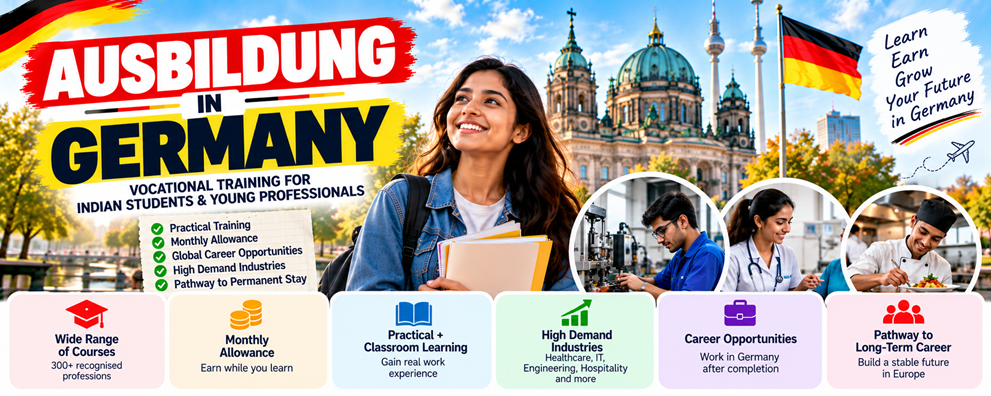
Ausbildung is Germany's vocational training system, through which trainees learn an occupation through structured practical experience and vocational education. Depending on the programme, trainees may receive a monthly training allowance while developing skills for a specific profession.
Opportunities exist across areas such as healthcare, hospitality, logistics, retail, IT, mechatronics, and industrial occupations. However, not every programme is open to every international applicant, and eligibility depends on the employer, occupation, language proficiency, educational background, and visa requirements.
For Indian applicants, the important questions are straightforward: Which Ausbildung programmes can you pursue? How do you find a genuine training position? What allowance might you receive? And what must you do before travelling to Germany?
This guide explains the process step by step, with links to official German government resources.
Ausbildung is Germany's vocational education and training system. It prepares people for specific occupations through structured learning, practical training, and assessment.
There are two main types:
You train with a company and attend a vocational school (Berufsschule). You usually receive a monthly training allowance under the training contract.
Suitable for: Applicants seeking practical occupational skills and structured workplace experience.
You study primarily at a vocational school or specialised training institution, sometimes with practical placements.
Important: School-based programmes may be unpaid and may involve tuition or other costs, depending on the programme and institution. You must verify how living expenses will be funded.
Germany has more than 300 recognised vocational training occupations. The best choice depends on your interests, educational background, language skills, and the requirements of the training employer.
Sector | Example Ausbildung occupation | German search term |
|---|---|---|
Healthcare | Nursing professional |
|
IT | IT specialist |
|
Engineering | Mechatronics technician |
|
Manufacturing | Industrial mechanic |
|
Electrical | Electronics technician |
|
Logistics | Warehouse logistics specialist |
|
Hospitality | Hotel specialist |
|
Retail | Salesperson |
|
Food and hospitality | Cook |
|
Automotive | Automotive mechatronics technician |
|
These are examples of occupations to research, not a list of guaranteed vacancies or a statement that every role is open to international applicants.
Ask yourself:
Do I enjoy technical, practical, customer-facing, or healthcare work?
Does the occupation match my school education and interests?
Am I prepared to learn and work in German?
Can I meet the training provider's academic and language requirements?
Does the training allowance and location make financial sense?
What career opportunities could follow completion of the programme?
Do not choose an occupation solely because a recruiter claims that it offers a high salary. Choose a profession you can realistically train for and perform.
There is no single educational eligibility rule that applies to every Ausbildung occupation. Employers may set their own requirements, and particular professions can have additional conditions.
Generally, you should investigate the following:
Education: Your school-leaving certificate and subjects must meet the employer's or programme's requirements.
German language: You need sufficient German for vocational school, workplace instructions, examinations, and daily communication.
Training contract: For the standard vocational training visa, you generally need confirmation of a specific training place in Germany.
Financial resources: You must demonstrate that your living expenses are covered under the applicable rules.
Visa eligibility: As an Indian citizen, you generally need the appropriate visa or residence permit before beginning training in Germany.
For a vocational training visa, German proficiency at B1 level is normally required if the training institution has not already assessed your language skills or you have not completed an appropriate preparatory course. The precise requirement can depend on the case.
No. Applicants with different educational and professional backgrounds may explore suitable programmes, but the employer and occupation determine the entry requirements. Your previous degree does not automatically make you eligible for every training position.
B1 is a common starting benchmark for the vocational training visa, but it does not mean every employer will accept B1 for every occupation.
Some training providers may expect stronger German skills, particularly where the role involves patient care, complex instructions, safety-sensitive work, or extensive customer communication.
A practical preparation path is:
A1–A2: Build basic vocabulary, grammar, listening, and everyday communication.
B1: Develop the ability to handle familiar situations and communicate about work and daily life.
B2: Strengthen comprehension, workplace communication, and the ability to participate in more demanding discussions.
These are learning stages, not universal admission rules. Check the employer's stated language level and any professional requirements before applying.
Practical tip: Start German-language learning before searching for a training contract. It can help you understand job descriptions, communicate with employers, and prepare for interviews.
During company-based Ausbildung, trainees normally receive a monthly training allowance, known as Ausbildungsvergütung. The amount depends on the occupation, employer, region, training year, and any applicable collective agreement. School-based programmes are often unpaid.
Not necessarily. Your rent, food, transport, insurance, and other expenses will determine whether the allowance is sufficient.
Before accepting an offer, calculate the difference between your expected take-home allowance and your actual monthly expenses. If the amount is insufficient for the applicable visa requirements, you may need additional proof of funds.
Indian citizens generally need a national visa or appropriate residence permit to undertake vocational training in Germany.
For the standard vocational training route, the official German government guidance identifies three central requirements:
A specific vocational training place in Germany.
Sufficient German-language skills, normally B1 where the stated exceptions do not apply.
Evidence that you can cover your living expenses for the duration of the stay.
The official Make it in Germany portal lists the following benchmarks:
Training pathway | Financial benchmark |
|---|---|
Company-based training | At least €1,048 gross or €822 net per month for the standard livelihood-sufficiency assessment |
School-based training | At least €959 net per month available to cover living costs |
If your company-based training allowance is below the applicable benchmark, you may be able to cover the shortfall through an accepted form of additional financial proof, such as a blocked account or declaration of commitment. For school-based training, accepted proof can include a blocked account, scholarship, or declaration of commitment, subject to the rules.
These are immigration financial benchmarks, not universal salary amounts. The exact assessment depends on your case, and you should verify the latest rules before applying.
7. Can You Travel to Germany to Search for an Ausbildung Position?
Germany also has a separate visa route for eligible applicants seeking a vocational training place.
According to the official government guidance, applicants generally need to:
Be under 35 years of age.
Have a school-leaving qualification that permits access to higher education or an eligible qualification from a German school abroad.
Demonstrate German at B1 level.
Prove sufficient funds, with a 2026 benchmark of €1,091 per month or an accepted alternative.
This route can allow eligible applicants to stay in Germany for up to nine months to look for a training position. During that period, the official guidance permits employment for up to 20 hours per week and trial work for up to two weeks, subject to the applicable conditions.
Important: This is not the same as receiving an Ausbildung contract from India. The eligibility criteria and financial obligations differ, so compare both routes carefully before deciding.
Ausbildung Pflegefachkraft 2027
Ausbildung Fachinformatiker 2027
Ausbildung Mechatroniker 2027
Ausbildung Hotelfachmann 2027
Ausbildung Fachkraft für Lagerlogistik 2027
Change the year or location to match the actual vacancy. A search result is not proof that the employer currently has an opening or accepts applications from overseas.
Prepare a clear application folder. The exact requirements vary by employer and occupation, so follow the instructions in each advertisement.
Common documents include:
Valid passport and contact details.
CV or résumé.
Cover letter explaining your motivation.
School-leaving certificates and transcripts.
German-language certificates, if required.
Relevant internships, experience certificates, or training records.
Translations or certified copies where requested.
After receiving a training offer, you will generally need the training contract or formal confirmation of the place and the documents specified by the relevant German mission.
Use the exact name of the occupation in your cover letter.
Explain why you want to train in that profession.
Highlight relevant school subjects, projects, and practical experience.
State your actual German-language level honestly.
Make sure your CV and certificates contain consistent personal details.
Submit documents in the language and format requested by the employer.
Choose your occupation
Research the training content, language requirements, and employment prospects.
Search for vacancies
Use official portals and company websites, and check start dates and eligibility requirements.
Prepare your application
Tailor your CV and cover letter to each employer.
Attend interviews or assessments
Be prepared to explain your motivation, language ability, and understanding of the occupation.
Review the training contract
Check the allowance, training duration, working hours, holiday entitlement, location, and any conditions.
Apply for the appropriate visa
Follow the current German national visa process and provide the required documents and proof of funds.
Prepare for relocation
Plan accommodation, insurance, travel, and arrival formalities only when your immigration position allows it.
Completing vocational training can provide a pathway toward qualified employment, depending on your occupation, employer, skills, and the job market.
After successful completion, eligible graduates may be able to remain in Germany for up to 18 months to look for qualified employment, subject to the applicable residence rules.
Your next steps may include:
Applying for qualified positions in your trained occupation.
Seeking a suitable job with your training employer.
Building additional technical or language skills.
Meeting the requirements for the appropriate employment residence permit.
However, completing Ausbildung does not guarantee a job, a particular salary, or permanent residence. Your subsequent options depend on the rules and your individual circumstances.
Be cautious of anyone promising a guaranteed German training contract, guaranteed visa approval, or an unusually high allowance in exchange for an advance payment.
Before paying any recruitment or service fee:
Verify the employer through its official website.
Confirm that the training position and contract are genuine.
Check the allowance, training duration, and responsibilities.
Verify visa requirements through official German government sources.
Request written terms for any service you are buying.
Never submit false certificates or misleading information.
13. Frequently Asked Questions
Company-based Ausbildung generally involves a training allowance rather than tuition fees paid by the trainee, but living expenses and other costs still apply. School-based programmes may have fees and may not provide a training allowance. Check the individual programme.
Yes, Indian applicants can investigate suitable programmes after Class 12, but the employer and occupation determine the accepted qualifications. German proficiency and visa eligibility must also be considered.
B1 is normally the language benchmark for the vocational training visa where the specified exceptions do not apply. Individual employers and occupations may require a higher level.
For applicable training contracts beginning in 2026, the statutory minimum is €724 gross per month in the first year, €854 in the second, €977 in the third, and €1,014 in the fourth. Actual allowances vary, and specific exceptions or collective agreements can affect the amount.
Holders of the relevant vocational training residence permit may undertake a separate job for up to 20 hours per week, subject to the applicable rules. The additional work must not replace or interfere with the training obligations.
You can search vacancies, apply to employers, and attend interviews from India. If you secure a qualifying training place, you can then investigate the appropriate visa process. You do not have to assume that you must first travel to Germany to begin applying.
Ausbildung can be a valuable route for Indian applicants who want practical occupational training in Germany. But success depends on choosing the right occupation, developing German-language skills, finding a genuine training position, understanding the financial requirements, and preparing the correct visa application.
Start with official job portals, check every employer's requirements, and calculate whether the training allowance and your available funds can support your living expenses.
Your next step is to select one or two occupations, begin preparing your German-language skills, and apply to suitable training positions through verified channels.
EFOS – Education Future One Stop helps students and professionals explore education pathways, skill development, and career opportunities.
Website: https://efos.in/
Contact: +91 9403890820
Contact EFOS to explore relevant career guidance and understand the preparation needed for your chosen pathway.
Disclaimer: This article is for general educational and career-awareness purposes. Training allowances, eligibility requirements, language expectations, and immigration rules vary and may change. The 2026 figures cited above should be verified through official sources before you make decisions. No training position or visa outcome is guaranteed.