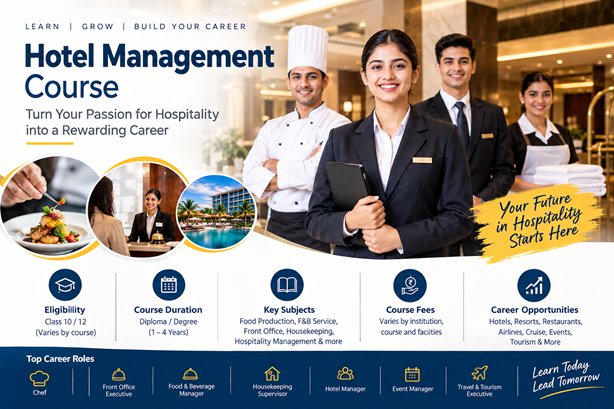
The Hotel Management course is a professional education program designed for students who want to build careers in the hospitality, hotel, tourism, food service, aviation, cruise, event management, and related industries.
Hotel management is no longer limited to working in hotels. The hospitality industry offers career opportunities across hotels, resorts, restaurants, airlines, cruise ships, airports, travel companies, catering companies, event management companies, clubs, hospitals, corporate cafeterias, and luxury service businesses.
With the growth of domestic and international tourism, food services, travel, events, and organised hospitality businesses, trained hospitality professionals continue to have opportunities in India and overseas.
A Hotel Management course provides students with practical and theoretical knowledge required to manage different operations of a hotel or hospitality business.
Depending on the level and duration of the program, students may learn:
Food Production and Culinary Skills
Food and Beverage Service
Front Office Operations
Housekeeping Operations
Hospitality Management
Hotel Accounting
Hospitality Marketing
Customer Service
Communication Skills
Personality Development
Food Safety and Hygiene
Event Management
Tourism Management
Hospitality Technology
Hotel Sales and Revenue Management
Leadership and Team Management
The objective is to prepare students for employment, professional growth, entrepreneurship, and managerial roles in the hospitality sector.
Hotel management is suitable for students who enjoy working with people, communication, service, food, travel, events, and dynamic work environments.
Some important reasons to consider a career in hospitality include:
Students can choose from several departments such as food production, front office, housekeeping, food and beverage service, sales, marketing, events, and hotel operations.
Hotel management education generally combines classroom learning with practical training, laboratory work, industrial exposure, internships, and workplace experience.
Hospitality professionals can explore employment opportunities in India as well as international hospitality markets, depending on their qualifications, skills, experience, and employer requirements.
Hotel management graduates can work in restaurants, resorts, cruise companies, airlines, catering, event management, tourism, corporate hospitality, healthcare hospitality, and other service industries.
Students with appropriate skills and experience can also start businesses such as restaurants, cafés, catering services, cloud kitchens, bakeries, food businesses, event services, or other hospitality ventures.
Hotel management courses are available at different educational levels. The eligibility criteria depend on the specific program and institution.
Students who have completed Class 10 or Class 12 may be eligible for different diploma, certificate, undergraduate, or other hospitality programs.
Typical eligibility may include:
Completion of Class 10 for selected certificate or diploma programs
Completion of Class 12 for undergraduate degree programs
English-language proficiency may be required for some programs
Admission requirements vary by university, college, and course
Students should always check the latest eligibility and admission requirements of the specific institution before applying.
A comprehensive hotel management curriculum can cover the following areas.
Students learn the fundamentals of cooking, kitchen operations, food preparation, ingredients, kitchen equipment, menu planning, and food production management.
This area focuses on restaurant operations, service techniques, beverage service, guest interaction, table service, and restaurant management.
Front office training includes reservations, reception, check-in and check-out procedures, guest relations, hotel information systems, and front-office operations.
Students learn room management, cleaning standards, linen management, housekeeping procedures, hygiene, maintenance coordination, and guest service.
Students develop knowledge of hotel operations, business management, leadership, team management, customer experience, and service quality.
Communication, English language skills, interpersonal skills, grooming, professional etiquette, teamwork, and confidence are important components of hospitality careers.
Students learn the importance of food hygiene, personal hygiene, sanitation, safe food handling, and food safety practices in hospitality operations.
The duration depends on the type of program.
Common formats include:
| Program Type | Typical Duration |
|---|---|
| Certificate Course | A few weeks to several months |
| Diploma in Hotel Management | Approximately 1–2 years |
| Undergraduate Degree | Usually 3–4 years |
| Postgraduate Program | Usually 1–2 years |
The actual duration, curriculum, eligibility, and certification depend on the institution offering the program.
Academic qualifications are important, but hospitality employers also value practical and interpersonal skills.
Important skills include:
Communication
Customer service
English language proficiency
Teamwork
Leadership
Problem-solving
Time management
Professional grooming
Attention to detail
Adaptability
Patience
Food safety awareness
Digital skills
Sales and service skills
Students should focus on developing both technical hospitality skills and employability skills.
A Hotel Management qualification can open career opportunities in multiple areas.
Possible job roles include:
Hotel Operations Executive
Hotel Supervisor
Duty Manager
Operations Manager
Hotel Manager
Front Office Associate
Guest Relations Executive
Front Office Supervisor
Front Office Manager
Reservation Executive
Commis Chef
Chef
Sous Chef
Kitchen Supervisor
Executive Chef
Restaurant Associate
Captain
Restaurant Supervisor
Food and Beverage Manager
Housekeeping Associate
Housekeeping Supervisor
Executive Housekeeper
Sales Executive
Business Development Executive
Hotel Sales Manager
Marketing Executive
Event Executive
Event Coordinator
Banquet Manager
Conference and Events Manager
Career progression depends on the student's qualification, skills, employer, location, experience, and performance.
Hotel management professionals can explore opportunities across:
Hotels
Luxury Resorts
Restaurants
Cafés
Catering Companies
Cloud Kitchens
Cruise Lines
Airlines
Airports
Event Management Companies
Travel and Tourism Companies
Corporate Hospitality
Hospitals and Healthcare Hospitality
Clubs
Institutional Catering
Food Service Companies
Government and public-sector hospitality organisations
Hospitality is a global industry. Students who develop strong professional skills, communication abilities, relevant qualifications, and industry experience may explore international career opportunities.
International hospitality careers can be available in areas such as: