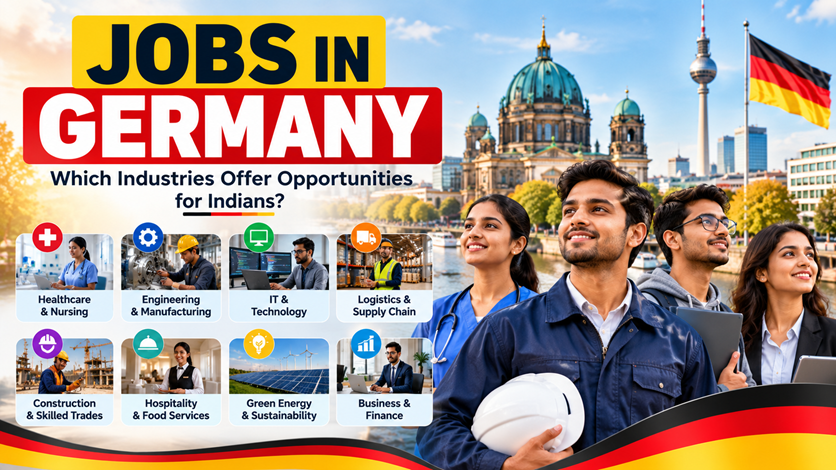
Germany is known for its engineering, manufacturing, automotive, technology, healthcare, and logistics industries. For Indian students, skilled workers, graduates, and experienced professionals, it can be a destination worth exploring for international career opportunities.
But finding a job in Germany involves more than submitting a CV. Candidates need to understand which occupations match their qualifications, whether their credentials are recognised, how much German they need, and which visa or employment pathway applies to them.
In this article, EFOS.in explores major industries in Germany, potential career roles, preparation requirements, and practical steps Indian candidates can take to begin their job search.
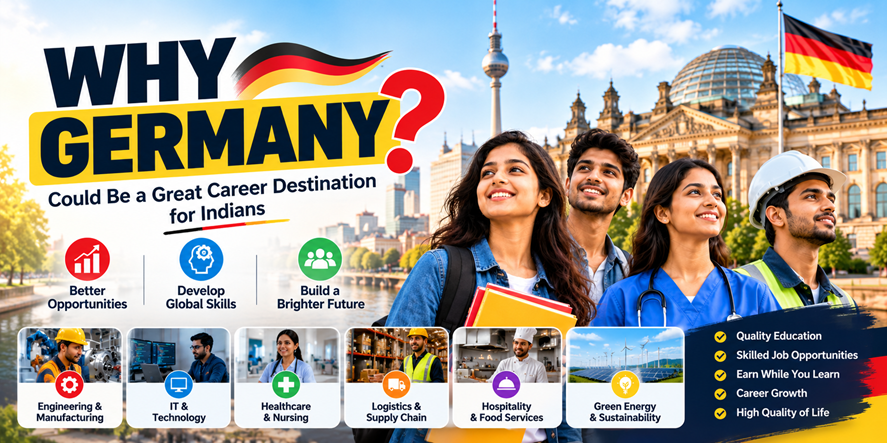
Germany has a diverse economy, with opportunities across technical, professional, industrial, and service sectors.
For Indian candidates, some potential advantages include:
Opportunities to develop specialised professional skills.
Exposure to international workplace practices.
Career pathways in technical and knowledge-based industries.
Vocational training options for eligible candidates who need occupational qualifications.
Potential long-term career development through experience and further training.
However, opportunities vary by occupation, region, employer, and economic conditions. Not every industry is experiencing the same level of demand, and a qualification that is valuable in India may require additional recognition or training in Germany.
The best approach is to identify a suitable occupation first, then research actual vacancies and eligibility requirements.
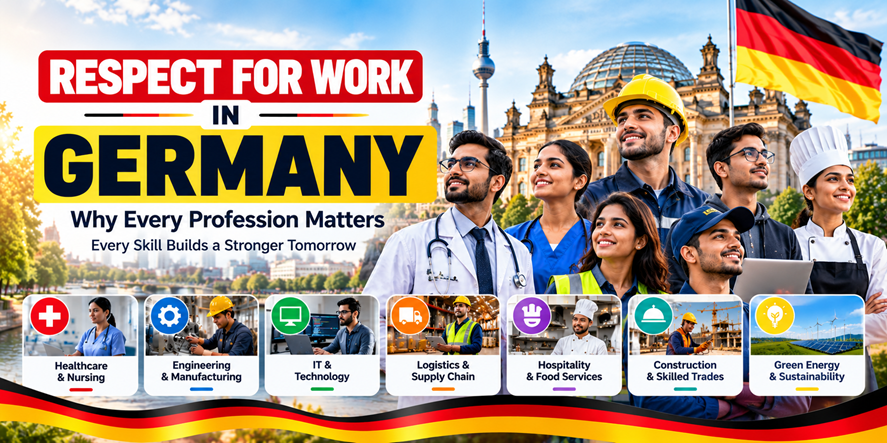
Germany offers a variety of career fields. The following industries are useful starting points for Indian job seekers.
Healthcare is one of the areas where Germany continues to face staffing challenges. The Federal Employment Agency's 2026 analysis identified healthcare and nursing among the sectors with particularly persistent shortages.
Potential career paths include:
Registered nursing professional
Qualified healthcare professional
Medical and healthcare support roles
Selected healthcare administration positions
What should Indian candidates know?
Nursing and other regulated healthcare professions generally require the appropriate recognition of qualifications and, where applicable, a licence to practise. German-language proficiency is also important for patient communication.
This field may suit candidates with relevant healthcare education and a willingness to complete the necessary recognition and language requirements.
Germany has a long-established industrial base, including machinery, electrical equipment, automotive production, and advanced manufacturing.
Potential roles include:
Mechanical engineer
Electrical engineer
Mechatronics technician
Production engineer
Quality assurance specialist
Industrial maintenance technician
Indian engineering graduates, diploma holders, and experienced technicians can research these opportunities based on their qualifications.
Employers may expect knowledge of technical standards, industrial safety, manufacturing processes, automation, and relevant software tools.
Germany's digital economy includes software development, IT services, business systems, data, and cybersecurity.
Possible career roles include:
Software developer
Data analyst
Cloud or systems engineer
Cybersecurity specialist
IT support professional
Enterprise application specialist
Candidates should develop practical skills and build a portfolio of relevant projects where appropriate.
English may be sufficient for some roles, but German can broaden the range of employers and workplace opportunities available to you.
Importantly, IT should not be treated as an automatic route to employment. Germany's Federal Employment Agency reported that software development was no longer among the occupations with identified bottlenecks in its 2025 shortage analysis.
Germany's role in European trade and distribution creates a broad logistics ecosystem, although vacancies vary by location and occupation.
Potential career paths include:
Warehouse logistics specialist
Supply chain coordinator
Transport and distribution operations
Inventory control specialist
Logistics analyst
Procurement and operations support
Candidates with logistics, business, or supply chain qualifications may investigate relevant roles. Some operational positions require specific vocational training, licences, or experience.
German-language skills are especially useful in roles involving warehouse teams, transport coordination, safety procedures, or customer communication.
Germany also needs qualified people in parts of the construction and skilled-trades workforce. Its Federal Employment Agency identified continuing shortages in construction and skilled trades in its 2026 analysis.
Potential fields to explore include:
Electrical installation
Plumbing and heating systems
Construction trades
Industrial electrical maintenance
Building technology
Skilled technical services
Requirements vary considerably. Applicants should check the occupational qualification, relevant safety standards, and whether formal recognition is needed for their intended role.
For candidates who do not yet possess the required occupational qualification, a suitable vocational training route may be worth investigating.
Hospitality offers career pathways for people interested in hotels, restaurants, food preparation, and guest services.
Possible roles include:
Hotel operations professional
Chef or cook
Restaurant service professional
Food and beverage operations
Guest relations
Hospitality management
Practical experience, customer-service skills, reliability, and communication are important. German is often useful for interacting with guests and colleagues.
Candidates should carefully distinguish entry-level service positions from qualified roles that require formal training or substantial experience.
Germany's energy transition has created opportunities across renewable energy, energy efficiency, and environmental technology.
Potential fields include:
Solar and wind energy technology
Electrical systems and energy infrastructure
Energy efficiency
Environmental engineering
Sustainable manufacturing
Energy project operations
These fields can be relevant to candidates with electrical, mechanical, environmental, or related technical backgrounds.
The availability of specific jobs depends on the region, employer, project pipeline, and the qualifications required for each role.
The following table provides a practical starting point for career research.
Your background | Roles to investigate |
|---|---|
Class 12 pass | Eligible Ausbildung programmes and entry routes with appropriate training |
ITI or technical diploma | Relevant technical training, maintenance, production, or trade roles |
Mechanical engineering | Manufacturing, maintenance, quality, and production engineering |
Electrical engineering | Electrical systems, automation, energy technology |
Computer science or IT | Software, data, cloud, IT systems |
Nursing or healthcare | Appropriate recognised healthcare pathways |
Logistics or business | Warehouse operations, supply chain, procurement |
Hospitality | Hotel operations, culinary and food service careers |
This is a guide to possible directions, not a guarantee of eligibility or vacancies. The employer's requirements and the applicable immigration rules determine whether a candidate can pursue a particular position.
There is no single qualification requirement for all jobs in Germany. Requirements depend on the occupation, employer, and immigration pathway.
Before applying, consider these four factors.
Educational qualifications: Check whether your degree, diploma, or vocational certificate meets the employer's requirements.
Professional experience: Some positions accept recent graduates, while others require substantial experience or specialised skills.
German-language proficiency: Requirements vary by job. Healthcare, vocational training, customer-facing roles, and many workplace environments may require strong German skills.
Recognition of qualifications: Some professions are regulated and require formal recognition or a professional licence. For other occupations, recognition may not be mandatory to practise, although it can still matter for a work visa.
You can start checking your requirements through the official Recognition in Germany portal.
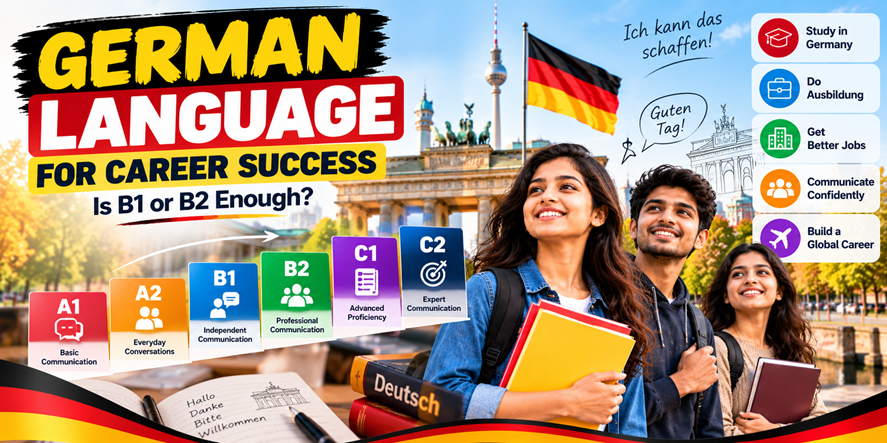
Your language needs depend on the role and employer.
Language level | General description |
|---|---|
A1–A2 | Basic communication and everyday situations |
B1 | Intermediate communication in familiar situations |
B2 | More confident communication in professional and complex situations |
C1 and above | Advanced communication for demanding language environments |
These levels describe general proficiency, not universal job-entry requirements.
Some international companies recruit for English-speaking positions. Other employers expect German proficiency, and regulated professions may impose specific language requirements.
Practical advice: Begin learning German early, even if you initially target English-speaking jobs. It can improve your ability to navigate daily life and expand your employment options.
A structured search is more effective than applying randomly to hundreds of vacancies.
Identify your target occupation. Choose roles aligned with your education, experience, and interests.
Research genuine vacancies. Review the required qualifications, language level, salary information where available, and location.
Prepare a professional CV. Highlight relevant skills, responsibilities, qualifications, and measurable achievements.
Check qualification recognition. Find out whether your occupation requires recognition, an equivalence assessment, or a professional licence.
Apply directly to employers. Use legitimate job portals and company career pages, and prepare for interviews.
Confirm the appropriate immigration route. A job offer alone does not automatically grant permission to work in Germany.
Useful official resources include:
Make it in Germany — information for qualified professionals exploring employment and immigration pathways.
Federal Employment Agency Job Search — search vacancies in Germany.
Recognition in Germany — information about professional qualification recognition.
The appropriate route depends on your qualifications, employment situation, and personal circumstances.
Common pathways include:
Skilled-worker residence permits: For eligible professionals who meet the relevant qualification and employment requirements.
EU Blue Card: For eligible highly qualified professionals who satisfy the applicable job, qualification, and salary conditions.
Opportunity Card (Chancenkarte): A route that may allow eligible candidates to enter Germany to seek employment, subject to the applicable criteria.
Recognition-related pathways: For eligible candidates who need additional measures to obtain recognition of their professional qualifications.
Not every candidate qualifies for every route. Review the latest official guidance on German visa and residence options before making plans.
There is no single salary for a profession across Germany. Earnings depend on your occupation, qualifications, experience, employer, region, collective agreements, and working hours.
Before accepting an offer, evaluate:
Gross annual or monthly salary
Estimated take-home pay after applicable deductions
Rent and other living expenses
Health insurance and other contributions
Relocation expenses
Contract conditions and working hours
Compare the actual job offer with reliable salary information for the relevant occupation and region. Do not rely on social-media claims that promise a fixed salary for everyone moving to Germany.
Applying for jobs that do not match your qualifications.
Assuming every German employer recruits internationally.
Ignoring language requirements.
Overlooking recognition or licensing requirements.
Confusing gross salary with take-home pay.
Paying large recruitment fees without verifying the employer and the terms.
Assuming that a job offer automatically guarantees a visa.
Relocating without a realistic financial plan.
A credible opportunity should have a verifiable employer, a clear job description, transparent contract conditions, and a legitimate recruitment process.
Start with these five actions:
Select one or two occupations that match your profile.
Check the qualifications, experience, and language skills those jobs require.
Begin German-language learning if relevant to your chosen roles.
Prepare your CV and collect your educational and professional documents.
Research real vacancies and verify the applicable visa requirements.
For students who are not yet qualified for their target occupation, higher education or Ausbildung may be an alternative route to consider.
Can Indians get jobs in Germany?
Yes, eligible Indian candidates can pursue employment in Germany through the applicable pathways. Success depends on qualifications, job availability, employer selection, and immigration requirements.
Which jobs are in demand in Germany?
The German Federal Employment Agency's 2026 analysis identified continuing shortages in healthcare and nursing, construction and skilled trades, among other fields. Demand changes over time and varies by occupation and location.
Some jobs use English as their primary working language, but German is important for many occupations and daily life. Regulated professions may have specific language requirements.
Can an ITI or diploma holder work in Germany?
Potentially, depending on the qualification, occupation, employer, and applicable visa conditions. Some candidates may need additional training or qualification recognition.
Can I get a job in Germany without a university degree?
Yes, some occupations and vocational pathways do not require a university degree. However, you must meet the requirements of the specific position and immigration route.
Germany offers a range of potential career pathways across technical, professional, industrial, and service sectors. The best opportunities for you will depend on your qualifications, practical skills, language proficiency, and the actual requirements of employers.
Instead of focusing only on which jobs are popular, identify the occupation that suits your background, check the relevant requirements, and prepare a realistic application strategy.
A successful international career begins with the right skills, verified opportunities, and informed decisions.
EFOS – Education Future One Stop
If you are an Indian student, diploma holder, graduate, or professional exploring opportunities abroad, start by understanding the education, training, and employment routes that may fit your profile.
Contact: +91 9403890820
Website: www.efos.in
Series: Career in Germany — Article 4 of 20 | EFOS.in
Next article: Article 5 — Why Germany Could Be a Great Career Destination for Indians.