
Power Transmission & Distribution | Lesson
Mark this lesson as complete
Finish all lessons and pass the quiz to earn your official course completion certificate.

Power Transmission & Distribution
Video Power, Control & Automation

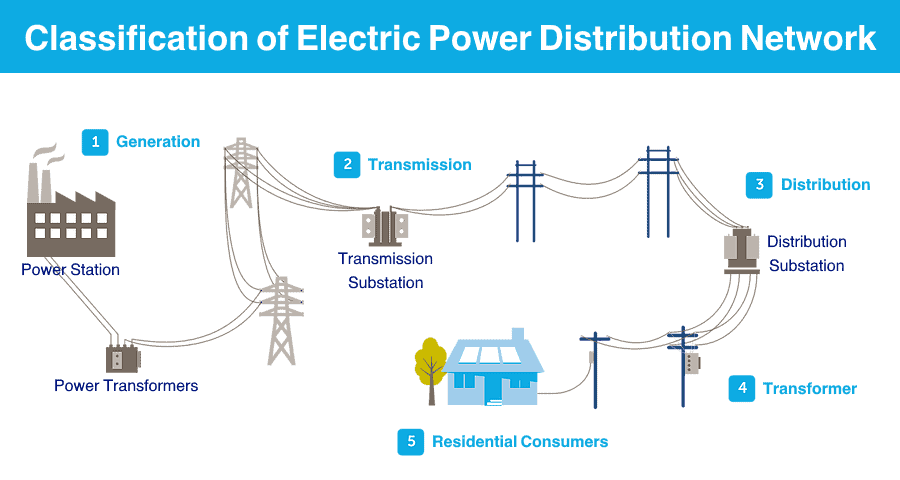
Power Transmission & DistributionClassification of Electric Power Distribution Network Systems

Power Transmission & Distribution (T&D) is the system that carries electrical power from power generation stations to end consumers (homes, industries, offices) safely and efficiently.

  1. Power Transmission:- Transmission is the process of transferring bulk electrical energy over long distances from power plants to substations.
    1. Key Features
      • Uses very high voltage (typically 66 kV, 110 kV, 220 kV, 400 kV or higher)
      • High voltage → low current → reduced power loss (I²R losses)
      • Usesoverhead lines or underground cables
      • Requires step-up transformers
    2. Purpose
      • Minimize energy loss
      • Carry power efficiently across cities and states
    3. Components
      • Transmission towers & conductors
      • Insulators
      • Circuit breakers
      • High-voltage substations
  2. Power Distribution:- Distribution is the process of delivering electricity from substations to final consumers.
    1. Key Features
      • Uses lower voltages (33 kV, 11 kV, 415 V, 230 V)
      • Voltage is reduced using step-down transformers
      • Directly supplies power to users
    2. Types of Distribution
      • Primary Distribution – 11 kV or 33 kV
      • Secondary Distribution – 415 V (3-phase) / 230 V (single-phase)
    3. Components
      • Distribution transformers
      • Poles & service lines
      • Switchgear & meters
      • Consumer wiring
  3. Transmission vs Distribution (Quick Comparison)
    FeatureTransmissionDistribution
    Voltage LevelVery HighMedium / Low
    DistanceLongShort
    ConsumersSubstationsEnd Users
    LossesVery LowComparatively Higher
    TransformersStep-UpStep-Down
  4. Importance of Power T&D
    1. Ensures reliable electricity supply
    2. Reduces energy losses
    3. Maintains voltage stability
    4. Supports industrial & economic growth
  5. Simple Flow of Power System:- Power Plant → Step-Up Transformer → Transmission Lines → Substation → Step-Down Transformer → Distribution Lines → Consumer
PDF is not available for this lesson.

Recommended Courses

Diploma Mechanical Engineering – Industry Readiness & Interview Skills 8 hours
Intermediate

₹0.00

Diploma Mechanical Engineering – Industry Readiness & Interview Skills

A practical, self-paced course designed to prepare Diploma Mechanical Engineering students for entry...

Banking & Finance – Entry-Level Job Readiness 8-10 Hours
Beginner

₹0.00

Banking & Finance – Entry-Level Job Readiness

Banking & Finance – Entry-Level Job Readiness is a practical, self-paced program designed to build j...
Logistics & Supply Chain Management 8-10 Hours
Intermediate

₹0.00

Logistics & Supply Chain Management

Industry-focused training in logistics and supply chain management, covering terminology, procuremen...
Complete AI Course: Beginner to Advanced 3 MONTHS
Intermediate

₹0.00

Complete AI Course: Beginner to Advanced

Learn Artificial Intelligence from fundamentals to advanced Agentic AI through 8 structured modules...

BBA in Hospitality and Hotel Management 15 Days
Beginner

₹0.00

BBA in Hospitality and Hotel Management

BBA in Hospitality and Hotel Management एक 3 वर्षीय करियर-केंद्रित स्नातक कार्यक्रम है, जो छात्रों क...

Hotel Management Diploma ( RISE Program) - 1 Year Diploma- Learn and Earn 1 Year
Beginner

₹1000.00

Hotel Management Diploma ( RISE Program) - 1 Year Diploma- Learn and Earn

Hotel Management Diploma (RISE Program)- Learn & Earn Mode RISE: Real-world Integrated Skills for...