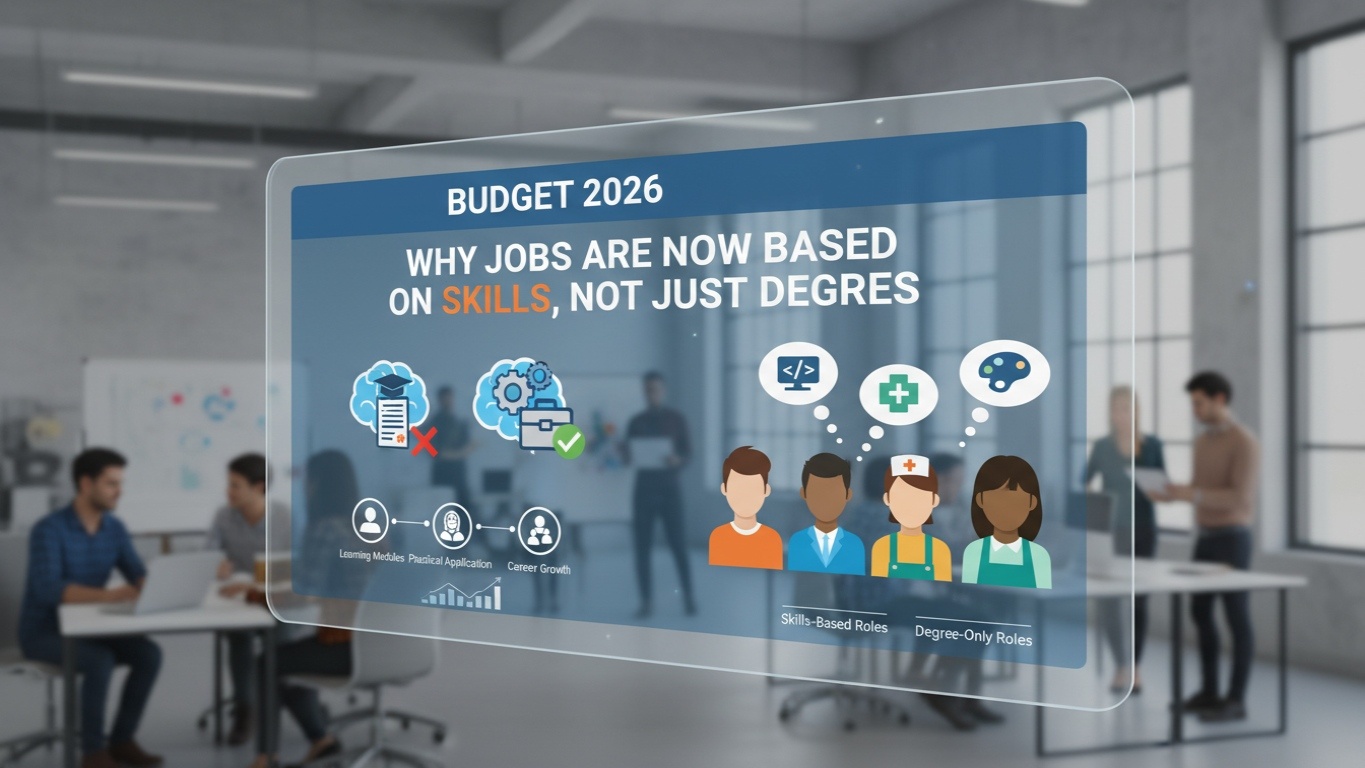
India’s education and employment landscape is undergoing a decisive shift. Budget 2026 sends a strong and unambiguous message:
👉 The future belongs to those who have skills, not just certificates.
For years, degrees were seen as the primary gateway to jobs. Today, industries are demanding job-ready talent, practical exposure, and real-world competencies. The latest budget acknowledges this reality and aligns national priorities with employability, skilling, and industry integration.
Budget 2026 places skill development at the center of India’s growth strategy. Instead of focusing only on long, theory-heavy education paths, the emphasis is now on:
Industry-aligned skills
Practical, hands-on training
Work-integrated education
Faster transition from learning to earning
This shift directly benefits students who want early career entry, financial independence, and real work experience alongside education.
One of the strongest themes of Budget 2026 is the expansion of Learn & Earn models. These programs allow students to:
Gain industry exposure while studying
Earn a stipend or salary during training
Reduce the financial burden on families
Build experience before formal graduation
This approach transforms education from a cost center into an investment, especially for youth from Tier 2, Tier 3, and rural India.
The budget gives special attention to first-time job seekers, including:
School pass-outs
ITI and diploma holders
Graduates looking for practical roles
By encouraging short-term, outcome-based training and apprenticeships, the government aims to bridge the gap between education and employment. This is a critical step toward reducing educated unemployment and improving workforce readiness.
Budget 2026 identifies key sectors where demand for skilled manpower is rising rapidly:
Hospitality and tourism
Services and customer experience
Manufacturing and MSMEs
Logistics and operations
Digital, AI, and emerging technologies
These sectors value attitude, adaptability, and practical skills more than just academic scores—opening doors for a wider range of learners.
Another major highlight is the encouragement of industry-academia partnerships. Institutions and training providers are being supported to work closely with employers to design:
Job-linked courses
On-the-job training modules
Paid internships and apprenticeships
Industry-recognized certifications
This ensures that students learn what the market actually needs, not outdated curricula.
In an age of automation and AI, routine tasks are being replaced—but human skills are becoming more valuable. Employers today seek professionals who can:
Communicate effectively
Solve real-world problems
Adapt to fast-changing environments
Combine technical knowledge with service mindset
Budget 2026 recognizes this reality and promotes a balanced approach: technology + human skills.
For students, the message is clear:
✔ Choose programs that lead to jobs
✔ Focus on practical learning and exposure
✔ Build skills that industry demands
For parents, it means rethinking success:
✔ A stable career doesn’t always require expensive, long-duration degrees
✔ Skill-first pathways can deliver faster and safer outcomes
Budget 2026 marks a turning point in India’s education-to-employment journey. It validates what industry has been saying for years: skills create careers.
As opportunities expand for job-linked education, apprenticeships, and learn-and-earn models, students who act early will gain a significant advantage.
The question is no longer “Which degree should I choose?”
The real question is: “Which skill will secure my future?”